
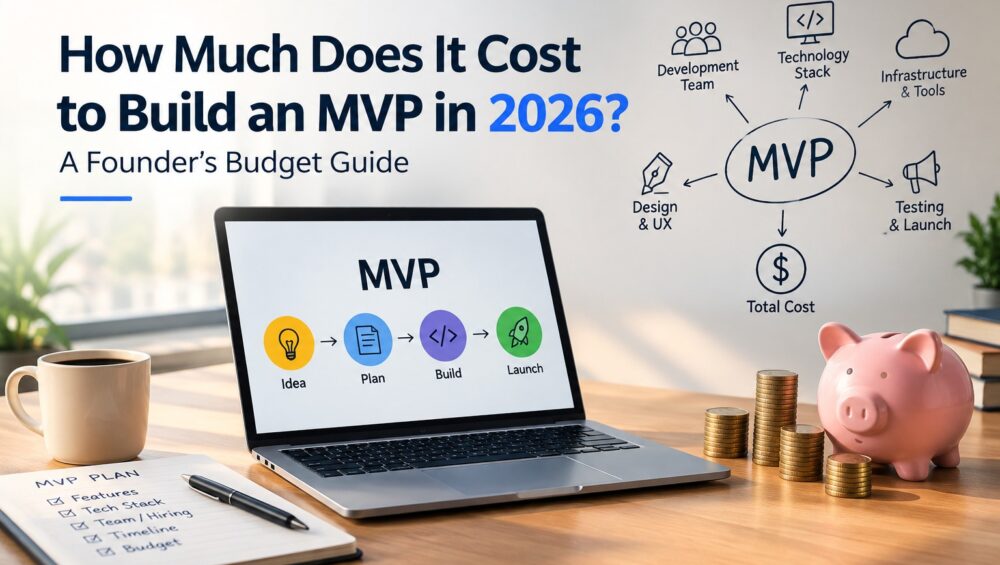
Every founder hits this question sooner or later: what’s it actually going to cost to build the thing?
The honest answer is that pricing swings widely – a lean web app sits at one end, a feature-rich native mobile app sits at the other. Where you land isn’t luck, it comes down to three choices: which platform you build for, how complex your features are, and whether you go native or hybrid. Understand how each one moves the number, and budgeting stops feeling like guesswork.
Here’s how each piece breaks down.
Cost by Platform: Web vs. iOS vs. Android vs. Hybrid
Platform is usually the first fork in the road—and the first thing that moves your MVP development cost up or down.
A web MVP – a browser dashboard, a SaaS tool, anything people log into from a laptop – is the most budget-friendly lane. One environment to build for, faster iteration, no app store approval slowing you down. If you just want to know whether people will use your product, this is usually the smartest place to start. If web is the direction you’re leaning, it helps to see what a proper build actually involves – here’s how web application development is typically scoped for early-stage products.
Native apps, built separately for iOS and Android, sit at the other end. You get the best performance and the deepest access to device features – camera, GPS, biometrics. But you’re effectively building two products, and that shows up directly in your startup app development cost, especially if you want both platforms live at launch.
Hybrid frameworks like React Native or Flutter split the difference: one codebase, two platforms, a noticeably smaller bill than going fully native. For most early-stage teams still validating an idea, hybrid tends to be the practical choice – solid performance without doubling your engineering effort.
Not sure you even need mobile yet? Start on web. You’ll learn what users want faster, and spend less finding out.
Cost by Feature Complexity
Platform sets your baseline. Features decide the real number on the invoice.
A simple MVP – a few core screens, basic login, one clear workflow – sits at the lower end of any minimum viable product budget. Think of a booking tool, a content app, or a marketplace built around one transaction type.
Costs climb fast once you add:
- Real-time features – chat, live tracking, push notifications
- Payment gateway integrations
- Third-party APIs – maps, CRMs, logistics tools, ERPs
- Admin dashboards and analytics
- Multiple user roles and permissions
None of these are wrong to want – but each adds hours, testing, and edge cases. The smarter move isn’t avoiding complexity, it’s sequencing it. Build the one feature that tests your core idea first. Let everything else follow once you know the idea works.
Native vs. Hybrid: What’s Actually Cheaper?
This is where founders often get the math wrong.
Native looks pricier upfront, and it is. But “cheaper now” and “cheaper overall” aren’t the same conversation. Hybrid saves money at launch but can hit performance limits as you scale, sometimes forcing a partial rewrite. Native costs more from day one but tends to scale more predictably.
So which fits you? If you’re validating an idea and speed matters more than polish, hybrid usually wins – lower MVP development cost, faster to market. If you already know your product needs heavy graphics, offline mode, or hardware integration, paying more for native now can save you an expensive rebuild later. Curious how this plays out for mobile-first products specifically? Here’s a closer look at mobile application development for startups weighing native against hybrid.
There’s no universal right answer – only the right one for where your product needs to be in the next twelve months.
How to Cut Costs Without Cutting Quality
You can control your budget without shipping something that feels cheap:
- Scope ruthlessly. Anything not essential to proving your core idea moves to phase two – the single most underused cost lever founders have.
- Reuse, don’t rebuild. Auth0, Firebase, Stripe, and Razorpay solve problems that would otherwise take weeks to build from scratch.
- Run design and development in parallel. Overlapping UI/UX with early backend work shortens your timeline – and a shorter timeline means a smaller bill.
- Commit to your platform strategy early. Switching from native to hybrid mid-build is one of the costliest mistakes a founder can make.
- Hire a team that’s built MVPs before, specifically. There’s a real difference between developers who write clean code and a team that knows how to build for speed today while leaving room to scale.
When to Hire a Development Partner vs. In-House
Before you post a job listing, ask: do you actually need full-time hires right now?
For most early founders, building in-house before validating an idea is a risky bet—you’re paying salaries and overhead before you know if the product resonates. If the market says pivot, an in-house team moves slower than a partner team built for exactly that flexibility.
A development partner gives you an entire experienced team—product, design, engineering, and QA—without fixed headcount costs. You pay for the work, not the payroll. It’s usually the more capital-efficient path from idea to testable MVP, and it keeps your startup app development cost predictable instead of open-ended.
In-house makes more sense once you’ve proven demand and need a team building your roadmap for years, not weeks.
Frequently Asked Questions
How much does it cost to build an MVP in 2026?
It depends mainly on platform choice and feature complexity. A simple web MVP lands at the lower end, a feature-rich native app at the higher end.
What’s the cheapest way to build an MVP?
A web app, or a hybrid framework if mobile is genuinely needed, combined with tight feature scoping and reused tools like Stripe or Firebase instead of custom-built systems.
Is hybrid app development cheaper than native long-term?
Not always. Hybrid is cheaper to launch but can hit performance limits at scale. Native costs more upfront but scales more predictably.
Should I hire in-house or a development partner for my MVP?
A partner is typically more capital-efficient before validation. In-house makes more sense once demand is proven and you need long-term ownership.
How long does it take to build an MVP?
Timeline tracks closely with cost – a tightly scoped web MVP moves fastest, while a native app with multiple integrations takes considerably longer.
What features should an MVP include?
Only what’s needed to test your core hypothesis. Real-time features, payments, and admin dashboards can usually wait for a later release.
Conclusion
There’s no single number that answers “what does an MVP cost?” But there is a reliable process for finding the real one for your product.
Platform, feature complexity, and the native-versus-hybrid decision all compound to shape your final minimum viable product budget. The founders who spend well aren’t the ones who spend least – they’re the ones who spend deliberately, on the right things, in the right order. That’s exactly the kind of budgeting approach the team at Precisio Technologies helps founders work through, from initial scoping to final build. You can browse a few case studies from teams that have shipped MVPs across web and mobile.
Get a free MVP cost estimate – talk to a team that’s scoped this exact question hundreds of times, and walk away with a number you can actually plan around.