If you run a distribution business, you probably know this routine well. Orders come in through WhatsApp and phone calls. Stock numbers sit in three different spreadsheets that never quite match. Dealers call to ask about schemes, and your sales team spends half the day chasing updates instead of selling.
Dealer and distributor management software fixes this by bringing orders, inventory, pricing and dealer communication onto one platform. Put simply, it gives everyone in your distribution network the same accurate, real-time information. Here’s how that actually improves day-to-day operations.
What Is Dealer and Distributor Management Software?
Dealer and distributor management software is a platform that helps manufacturers and brands manage their entire sales channel, from the company to distributors, dealers and retailers. It handles order booking, stock tracking, billing, schemes and performance reporting in one place.
It’s widely used in FMCG, electronics, lighting, auto parts, pharma and building materials. Basically, any business that sells through a network of partners rather than directly to customers can benefit from it.
What Problems Do Distributors Face Without a Proper System?
Most distribution headaches come from one root cause: scattered data. Without a central system, businesses usually struggle with:
- Manual order entry that leads to mistakes and delays
- Too much stock in one region while another runs out
- No clear view of what dealers are actually selling
- Confusion over schemes, discounts and pending payments
- Managers making decisions based on last month’s numbers
Each of these costs time and money, and they get worse as the network grows.
How Does Dealer and Distributor Management Software Improve Distribution Operations?
Faster, Error-Free Order Processing
Dealers place orders directly through a portal or app, and those orders go straight into your system. No retyping, no missed messages. Orders are automatically sent to the right warehouse, which means faster dispatch and far fewer “where is my order?” calls.
Real-Time Visibility Into Stock
You can see stock levels across warehouses, distributors and regions at any moment. Many systems also alert you before a product runs low, so you restock on time instead of reacting to shortages. The result is less dead stock and fewer lost sales.
Clear Tracking of Secondary Sales
Knowing what you sold to distributors is only half the picture. The software also tracks what distributors sell onward to dealers and retailers, showing which products are really moving in the market. This helps you plan production better and spot slow territories early.
Automated Pricing, Schemes and Billing
Territory-based pricing, discounts and target rewards are applied automatically, and invoices can sync with accounting tools like Tally. Dealers can see exactly what they’re eligible for, which removes a lot of back-and-forth and billing disputes.
Smarter Decisions With Live Dashboards
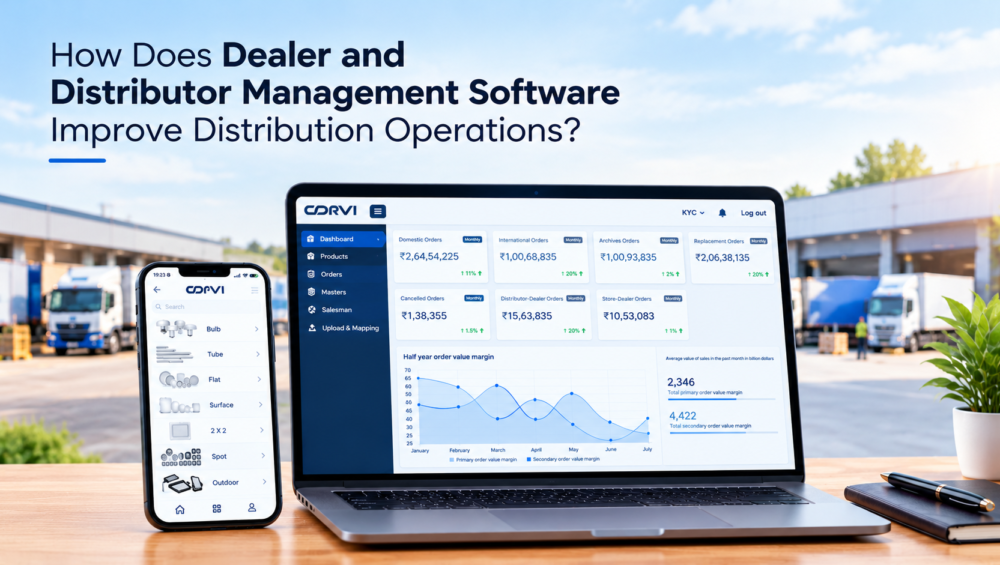
Live dashboards show sales, stock and dealer performance as they happen. Instead of waiting for month-end reports, managers can see which region is growing, which distributor needs support and where demand is shifting, and act on it the same week.
A real-world example: Corvi LED Limited, an architectural LED manufacturer, was managing suppliers, dealers and distributors through scattered spreadsheets and manual purchase orders. Stock was often too high in one region and missing in another. After moving to a centralized dealer and distributor management platform with QR-based product tracking, the company reduced administrative workload by 40%, improved inventory optimization by 30%, and onboarded more than 1,700 network partners within six months. See how Corvi LED transformed its distribution network →
Why Is a Mobile App Important for Dealer and Distributor Management?
Your sales reps and dealers are rarely sitting at a desk. A mobile app lets field teams book orders right at the dealer’s shop, check stock instantly and log visits on the spot. Dealers, in turn, can reorder, track deliveries and check schemes from their phone.
In practice, the app often decides whether the whole system gets used. If ordering through the app is easier than sending a WhatsApp message, adoption happens naturally. That’s why it’s worth partnering with an experienced mobile application development company that can build a fast, simple app, ideally with offline support for areas where the network is weak.
Should You Choose Ready-Made or Custom Distributor Management Software?
Ready-made tools are quicker to set up and work well for smaller networks with standard processes. But as your business grows, you may find they don’t fit your pricing rules, scheme structures or integrations with ERP, logistics and banking systems.
Custom software is built around how your business actually works. It takes more effort upfront, but it grows with you and saves your team from constant workarounds. Either way, plan for proper onboarding and training, because any system is only as useful as the data your team puts into it.
Final Thoughts: Is Dealer and Distributor Management Software Worth It?
For most growing distribution businesses, yes. It replaces guesswork with real visibility, cuts manual work, and helps you build stronger, more transparent relationships with your dealers. The sooner your network runs on accurate data, the easier it becomes to scale.
If you’re planning to streamline your distribution network, Precisio can help you design a solution that fits the way your channel actually works. Let’s talk about what your business needs.
Frequently Asked Questions
What is the difference between a DMS and an ERP?
An ERP manages internal operations like finance, production and HR. A distributor management system focuses on your sales channel outside the company, including distributors, dealers, orders and secondary sales. Many businesses connect the two so data flows smoothly between them.
Is dealer management software suitable for small distributors?
Yes. Smaller businesses often benefit the most because they’re moving away from manual work for the first time. You can start with core features like order booking and stock tracking, then add more as the network grows.
Can distributor management software work offline?
Many mobile apps are built to work offline. Sales reps can book orders without internet access, and the data syncs automatically once the connection returns. This is especially useful for field teams in rural or low-network areas.