
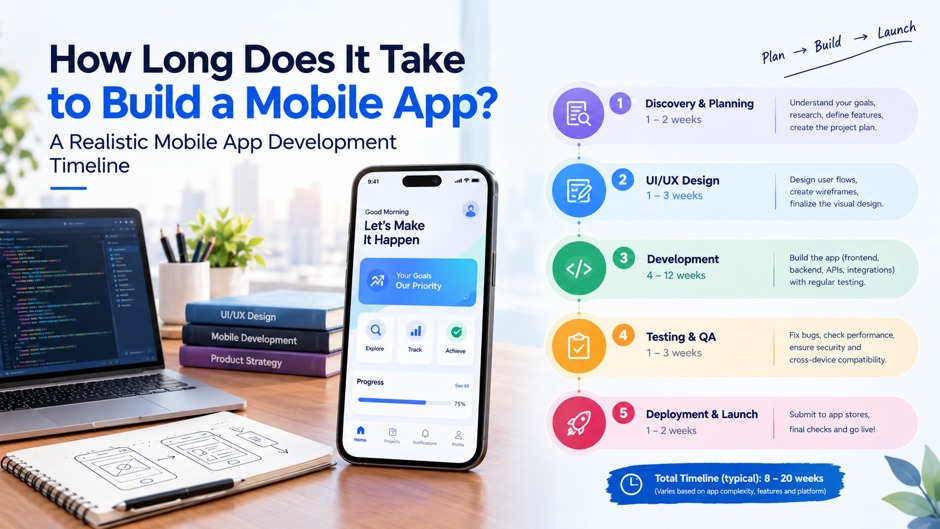
Most mobile apps take 3 to 9 months to build. A simple app can launch in 2–3 months. A complex app with custom features can take 9 months or more.
Your exact mobile app development timeline depends on your features, platforms and team. In this guide, you’ll learn how long each stage takes, what slows projects down, and how to launch faster without cutting corners.
Average Mobile App Development Timeline by App Complexity
Here’s a quick look at the average time to develop an app, based on how complex it is:
- Simple app (2–3 months): A few screens, basic login and no complex backend. Think of a calculator, a simple booking or an event app.
- Medium app (4–6 months): User profiles, payments, push notifications and third-party integrations. Think of a food ordering or fitness app.
- Complex app (9+ months): Real-time features, AI, heavy data or high security. Think of a banking, healthcare, or on-demand marketplace app.
These are ranges, not promises. A clear plan can keep your project on the shorter side.
Stage-by-Stage Breakdown of the App Development Process
Every app moves through the same core stages. Here’s how each one fits into your overall mobile app development timeline.
Discovery and Planning (2–4 Weeks)
The team studies your idea, your users and your competitors. Together, you define features, set priorities and agree on a roadmap. Skipping this step often leads to costly changes later.
UI/UX Design (3–6 Weeks)
Designers first create wireframes, which are simple sketches of each screen. Then they build the final visual design. A clickable prototype lets you test the flow before anyone writes code.
Development (8–20 Weeks)
This is the longest stage. Developers build the frontend, which is what users see. They also build the backend, meaning the servers, databases and APIs that power the app. Work usually happens in two-week sprints, so you see progress often.
Testing and Quality Assurance (2–6 Weeks)
QA testers check the app on different devices and screen sizes. They find bugs, run security checks and make sure the app performs well under heavy use. Much of this testing runs alongside development.
Launch and App Store Approval (1–2 Weeks)
Your app is submitted to the Google Play Store and the Apple App Store. Reviews usually take a few days. If a store rejects the app, fixes and resubmission can add extra time.
Key Factors That Affect Your Mobile App Development Timeline
- Number of features: Every extra feature adds design, coding and testing time.
- Platforms: Separate iOS and Android apps take longer than one shared app.
- Backend complexity: Custom servers, admin panels and integrations add weeks.
- Team experience: A skilled, dedicated team moves faster and makes fewer mistakes.
- Feedback speed: Slow approvals on your side can stall progress for days.
- Changing requirements: Adding features mid-project, known as scope creep, is the biggest cause of delays.
Native vs Cross-Platform: Which Gets You to Launch Faster?
Native apps are built separately for each platform. iOS apps use Swift, and Android apps use Kotlin. They offer top performance, but you maintain two codebases.
Cross-platform frameworks like Flutter and React Native use one codebase for both platforms. Because most code is shared, this approach can noticeably shorten your mobile app development timeline.
For most startups, cross-platform app development is the faster route to market. Native still makes sense for apps that need heavy graphics or deep access to device hardware.
How to Shorten Your Mobile App Development Timeline
- Start with an MVP. A Minimum Viable Product includes only your core features. It trims months off your mobile app development timeline and lets you improve based on real feedback.
- Lock your requirements early. A clear scope prevents rework.
- Use ready-made tools. Cloud services and pre-built APIs for login, payments and maps save weeks.
- Test continuously. Catching bugs early is faster than fixing them at the end.
- Work with an experienced team. Developers who have built similar apps already know the common pitfalls.
FAQs About App Build Time
Can I build a mobile app in one month?
Yes, but only a very basic app or a lean MVP. With a few screens, no custom backend and quick decisions, a small team can launch in 4–6 weeks. Apps with payments or user accounts usually need longer.
Does a longer timeline mean a higher app development cost?
Usually, yes. Most agencies charge based on team hours, so more weeks mean a bigger bill. Cutting features from version one is the easiest way to lower both time and cost.
How long does it take to update an app after launch?
Small fixes can go live within days. New features typically follow a 2–4 week sprint. Plan for ongoing updates, since new phone OS versions and user feedback will need attention.
Is it faster to hire a freelancer or an app development company?
A freelancer works well for a tiny app. For bigger projects, a company is often faster. Its designers, developers and testers work in parallel instead of one after another.
Plan Your App Launch With Confidence
A typical mobile app development timeline runs from 2–3 months for a simple app to 9+ months for a complex one. Features, platforms and team experience make the biggest difference. Start with an MVP, set a clear scope and test early to launch sooner.
Not sure where your idea fits? Browse our case studies to see apps we’ve delivered. Then talk to Precisio’s mobile app development team for a realistic timeline and plan. Book your free consultation today.